Google Business Profile, Social Media & Backlinks: The Trio That Drives Leads to Your Website
Most service businesses know they "need a website," so they finally invest in one—and then nothing really changes. The phone isn't ringing more. The inbox isn't filling up. It feels like all that effort went into something that just sits there collecting dust.
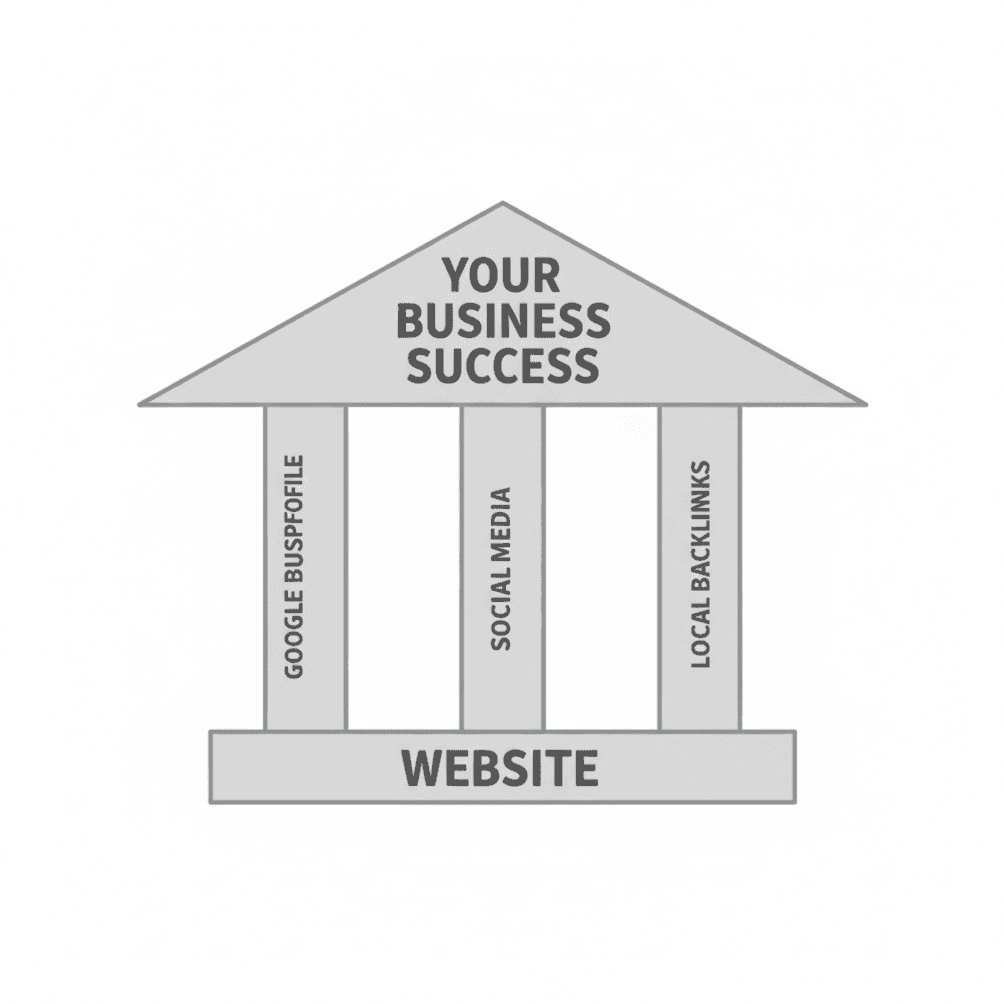
Here's the thing, though: the problem usually isn't that you have a bad website. The problem is that the website is the foundation, and it's missing the pillars that actually drive visibility and trust with local customers.
Here's the Framework
Your Website: The Foundation Everything Rests On
Your website is the starting point. It's the one thing you fully control—your services, pricing ranges, photos, and how people get in touch with you. Every other piece of your online presence either points back to it or backs it up.
A good website does three main jobs:
Makes you look credible when someone Googles your name
Explains what you actually do and where you work
Makes it easy to contact you with a clear next step
Quick gut check: Does your site load fast on mobile? Can a stranger tell within 10 seconds what you do? Is your phone number obvious at the top of the page? If the answer is "no" to any of these, start here. Everything else builds on a solid foundation.
Pillar 1: Google Business Profile – Your Local Storefront on Google
When someone types "[your service] near me," the first thing they see isn't your website—it's a map with star ratings. That's your Google Business Profile doing its job.
Why this matters for service businesses:
Shows up on Google Maps and in "near me" searches
Displays your reviews, photos, hours, and contact info right in the search results
Drives direct phone calls and website visits
Google Business Profile isn't just a listing—it's often the very first impression someone has of your business.
What to do Monday morning: Go to google.com/business, claim your profile, and fill out every single field. Upload photos, confirm your hours, and ask a couple of happy customers for a review.
Pillar 2: Social Media – Staying Top of Mind Between Jobs
Social media isn't about going viral. For service businesses, it's about staying visible in your community so that when someone needs what you offer, your name is already familiar.
What social media does for you:
Build familiarity: A customer hears about you from a friend, then sees your Facebook page has 50 posts over the last year and solid reviews. All of a sudden, you feel established.
Show your work: Before-and-after photos, quick tips, behind-the-scenes content—this stuff builds trust in a way that nothing on your website really can.
The social media reality:
You don't need to post every day. What you need is consistency. One good post per week on Facebook beats seven mediocre ones. Same goes for Instagram—quality over quantity, every time.
What to post:
Before-and-after photos (your bread and butter)
Quick tips your customers actually need (how to prep for your service, seasonal reminders)
Customer testimonials or tagged reviews
Behind-the-scenes shots (your team, equipment, the work in progress)
What to do Monday morning: Post one before-and-after photo on Facebook with a two-sentence caption. That's it.
What About Nextdoor?
Nextdoor is a neighborhood-based social network where locals recommend service providers. It can be a real asset for hyper-local businesses—especially handymen, landscapers, and cleaning services—but it's not essential right out of the gate. If you're already stretched thin, focus on Facebook and your Google Business Profile first. Nextdoor is a "nice to have" once those are solid and you're ready to expand.
Pillar 3: Local Backlinks & Listings – Signals That You're Credible
Local backlinks (other websites linking to yours) and directory listings tell Google one thing: this business is real, and people trust them.
This includes:
Industry directories (plumbing directories, HVAC directories, etc.)
Local business listings (Yelp, Angi, Home Advisor, etc.)
Community and chamber of commerce sites
Local news mentions or partnerships
You don't need to be listed everywhere. A few high-quality, consistent listings beat dozens of random ones every time.
What to do Monday morning: Google your business name and claim any unclaimed directory listings you find. Start with Yelp and your local chamber of commerce.
Real-World Example
Picture a roofer in Overland Park. His website looks professional, but he's sitting at 4 Google reviews and hasn't posted on Facebook in 8 months. Meanwhile, a competitor with a less polished website but 87 Google reviews and weekly Facebook posts is getting way more calls.
Why? Because the pillars are doing the heavy lifting.
Here's What You Actually Need to Do
Priority | Action | When |
|---|---|---|
First | Claim and optimize your Google Business Profile | This week |
Second | Post one before-and-after on Facebook | This week |
Third | Get claimed on Yelp and your local chamber site | Within two weeks |
Ongoing | Post once per week on Facebook or Instagram | Every week |
You don't need to tackle everything at once. Start with your Google Business Profile and one social media post. Once that feels like second nature, add the next pillar.
The Bottom Line
Your website is still the foundation. But a great website sitting by itself is like a beautiful building with no road leading to it. The pillars—Google Business Profile, social media, and local listings—are the roads that bring customers to your door.
Build one pillar at a time. Start with Google Business Profile. Add Facebook consistency. Claim your local listings. Do those things well, and the phone will ring.
Ready to get started? Pick one action from the table above and do it today.